
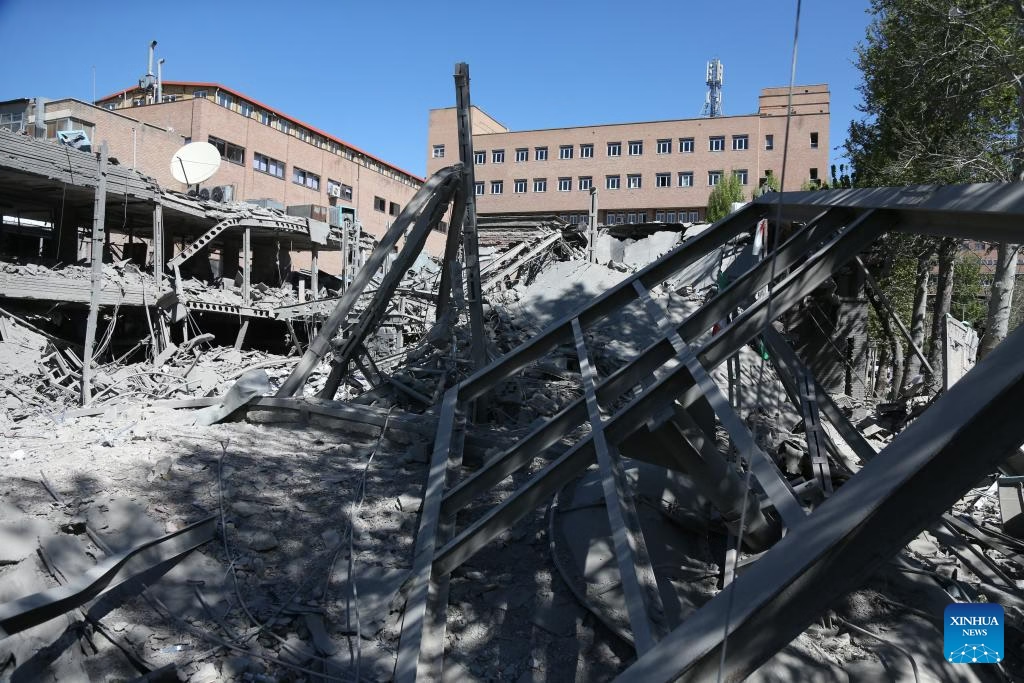
The recent US–Israeli military strikes on Iranian scientific and educational infrastructure have left a deep and measurable impact on the country’s research ecosystem. Early assessments from regional monitoring groups and satellite imagery indicate extensive damage to university laboratories, engineering departments, and several government‑linked research facilities. While the geopolitical implications dominate headlines, the long‑term consequences for global science, technology, and innovation are only beginning to surface.
1. Persian Scholars: A Legacy of Science and a Modern Global Footprint
Persian scientific tradition stretches back millennia. Ancient scholars such as Ibn Sina (Avicenna), Al‑Khwarizmi, Omar Khayyam, and Al‑Biruni shaped mathematics, astronomy, medicine, and engineering. Their works influenced the European Renaissance and remain foundational in modern STEM fields.
Today, Iranian scholars—both inside the country and across the diaspora—continue to contribute significantly to global science and technology:
Key Areas Where Iranian Scholars Lead or Contribute Strongly
- Artificial Intelligence & Operations Research Iranian researchers are highly visible in optimization, machine learning, and decision‑making sciences.
- The Best–Worst Method (BWM) was introduced by Jafar Rezaei (Netherlands).
- The Ordinal Priority Approach (OPA) was proposed by Amin Mahmoudi (China).
- Numerous modern optimization algorithms were developed by Seyedali Mirjalili (Australia), whose work is widely cited in AI and engineering.
- Aerospace & Astronomy Iranian‑born scientists have held major roles in NASA programs, including:
- Firouz Naderi (Mars exploration leadership)
- Jasmin Moghbeli (astronaut)
- Bobak Ferdowsi (Mars Curiosity mission)
- Mahta Moghaddam (Earth remote sensing)
- Computer Science & Mathematics
- Lotfi Zadeh, founder of fuzzy logic, reshaped control systems and AI.
- Ali Ghodsi, co‑founder of Databricks, is a major figure in cloud computing and big‑data engineering.
- Maryam Shanechi is a leading researcher in neural engineering and brain–machine interfaces.
- Caro Lucas contributed to intelligent control systems and swarm intelligence.
- Elham Tabassi has played a central role in US biometric standards and AI governance.
- Engineering, Physics, and Chemistry Iranian researchers consistently rank among the most published in materials science, nanotechnology, and chemical engineering.
Iran’s scientific diaspora is one of the most globally integrated in the world, with Iranian‑born scholars holding positions in top universities across North America, Europe, and Australia.
Iranian Influence in Global Scientific Publishing
A frequently overlooked dimension of Iranian scientific influence is the large number of Iranian or Iranian‑origin scholars serving as editorial board members and peer reviewers for top international journals. They hold positions in journals across:
- AI and machine learning
- Operations research
- Materials science
- Electrical engineering
- Biomedical engineering
- Environmental science
This presence gives Iranian scholars a significant role in shaping global research standards, peer‑review quality, and scientific direction. The strikes threaten to disrupt this pipeline of expertise.
2. Brain Drain: A Long‑Standing Challenge With Global Consequences
Iran has experienced one of the world’s highest rates of scientific emigration for decades. Economic instability, sanctions, and limited research funding have pushed many top students abroad.
Consequences for Iran
- Loss of high‑skill labor in AI, engineering, and medicine
- Reduced innovation capacity and slower commercialization of research
- Increased dependence on foreign technology
- Difficulty sustaining advanced research programs
Consequences for the International Community
- Global AI and OR research has benefited from Iranian talent, as seen in the widespread adoption of BWM, OPA, and modern metaheuristic algorithms.
- Iranian‑born scientists contribute heavily to US, European, and Chinese research output.
- The diaspora strengthens international collaboration networks.
The strikes risk accelerating this brain drain dramatically, as damaged institutions may take years to rebuild.
3. Iran’s Recent Push for Science, Technology, and AI
Over the past decade, Iran has invested heavily in:
- AI research centers
- Nanotechnology laboratories
- Biotechnology and pharmaceutical production
- STEM university expansion
- Defense‑linked engineering programs
- Start‑up incubators and innovation hubs
Iran ranked among the top 15 countries globally in nanotechnology publications and maintained strong output in AI and engineering despite sanctions. Government policy documents emphasized technological self‑sufficiency, digital transformation, and AI‑driven economic growth.
The strikes directly undermine these strategic priorities.
4. Damage to Universities, Research Centers, and Human Capital
While full verification is ongoing, early assessments from open‑source intelligence (OSINT), academic networks, and regional observers indicate:
Universities Reported as Damaged
(Damage levels based on satellite imagery, local reporting, and academic sources; subject to confirmation)
- Sharif University of Technology (Tehran) Damage to engineering labs and computing facilities; several buildings reported non‑operational. It is is widely referred to as “Iran’s MIT” or the “MIT of the Middle East” due to its status as the region’s premier engineering and science institution.
- Amirkabir University of Technology (Tehran Polytechnic) Structural damage to mechanical and electrical engineering departments.
- University of Tehran – Science & Engineering Campus Impacts to physics and chemistry laboratories.
- Isfahan University of Technology Reports of damage to materials science and aerospace research units.
- Iran University of Science and Technology Partial destruction of robotics and AI research labs.
- Government‑linked research centers Several facilities associated with advanced materials, satellite technology, and defense engineering were reportedly targeted.
Financial Costs
Preliminary economic estimates suggest:
- $1.5–3.2 billion USD in physical infrastructure damage
- $500–900 million USD in lost equipment, servers, and laboratory instruments
- Long‑term losses in research productivity potentially exceeding $10 billion USD over the next decade
Human Costs
- Displacement of thousands of students and researchers
- Loss of ongoing experiments, datasets, and prototypes
- Increased emigration intentions among STEM graduates
- Interruption of international collaborations and joint publications
For a country already struggling with sanctions and limited access to scientific equipment, the destruction of specialized labs—some of which took decades to build—represents a severe setback.
5. Global Implications: A Shock to International Science and Innovation
The strikes have consequences far beyond Iran’s borders.
Impact on Global Research
- Disruption of joint AI, physics, and engineering projects involving Iranian scholars
- Loss of unique datasets and experimental facilities
- Reduced diversity in global scientific collaboration networks
Impact on Regional Stability
- Damage to educational institutions can destabilize societies long‑term
- Loss of scientific capacity may push Iran to rely more heavily on foreign—often non‑Western—partners, shifting geopolitical alliances
Impact on Talent Flows
- A new wave of Iranian STEM migration is expected
- Western universities may see increased applications from displaced Iranian scholars
- China, Europe, and Canada may become primary destinations for high‑skill Iranian researchers
Impact on Global AI Development
Iranian researchers have been disproportionately influential in:
- Optimization algorithms
- Decision‑making models
- Neural engineering
- Control systems
- Fuzzy logic
- Aerospace engineering
A sudden disruption in Iran’s research ecosystem could slow progress in these fields, especially in areas where Iranian scholars have been leading contributors.
Conclusion
The US–Israeli strikes on Iran’s scientific and educational infrastructure represent more than a military event—they are a profound disruption to a nation with a deep scientific heritage and a globally influential diaspora. The damage threatens to accelerate brain drain, weaken regional stability, and reshape global research networks. As assessments continue, the international scientific community is already grappling with the long‑term implications for innovation, collaboration, and technological progress.