
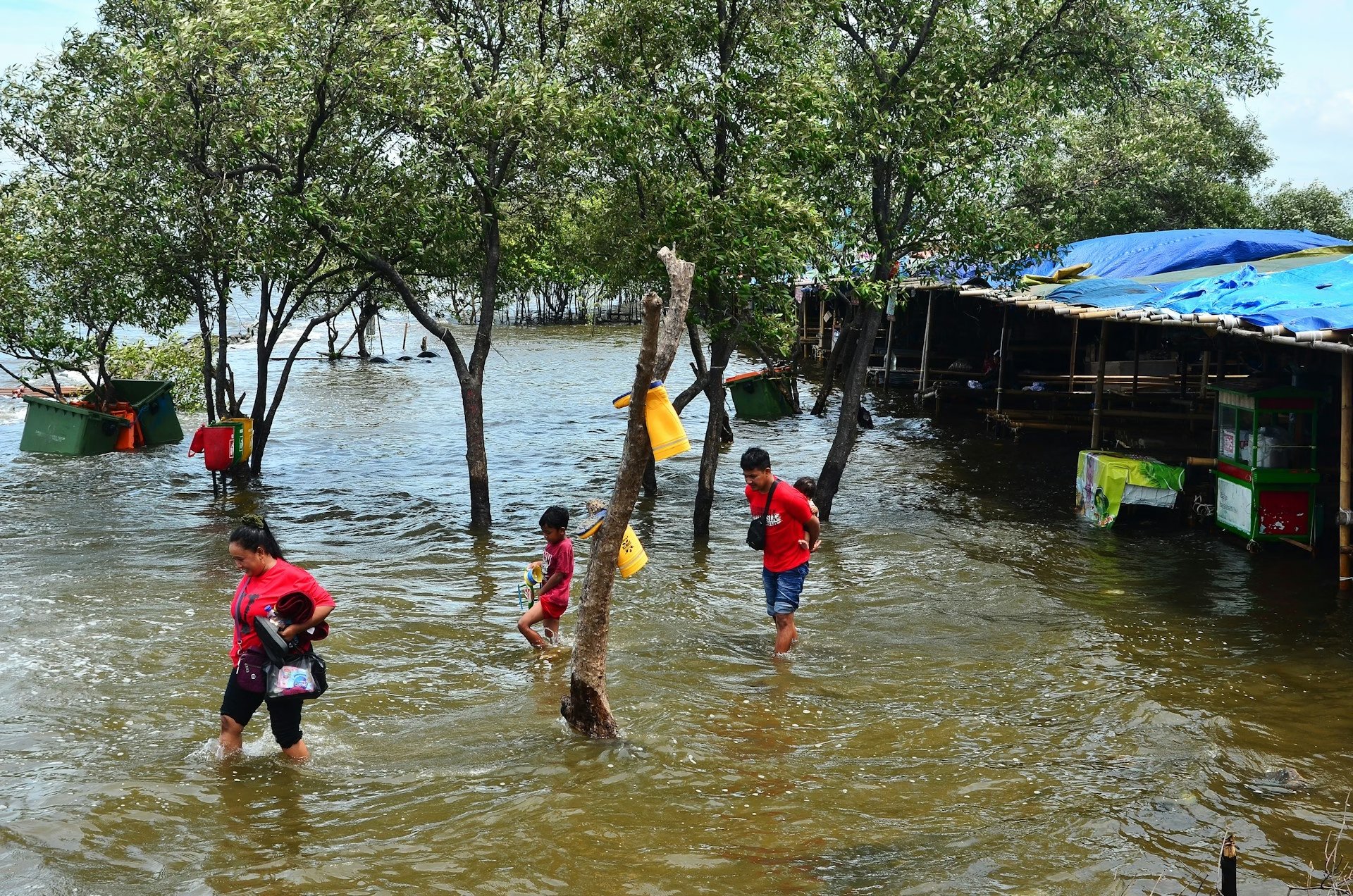
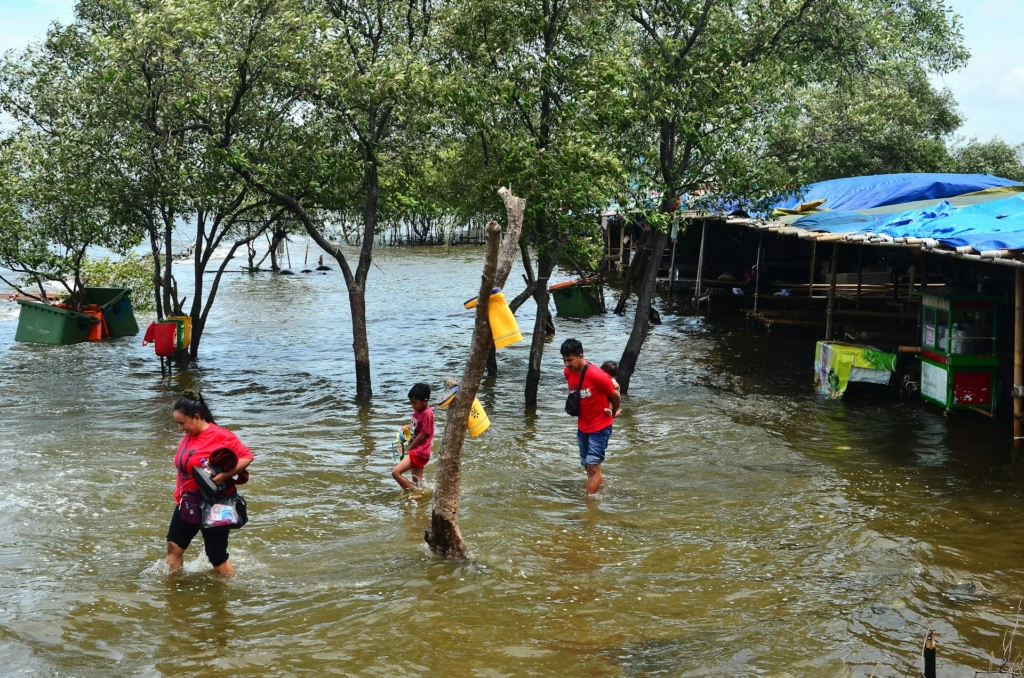
Recent oceanographic measurements from satellite altimetry, tide‑gauge networks, and climate monitoring agencies show a notable acceleration in sea level rise across several regions of the world. While global sea level has been increasing steadily for decades, new data from early 2024–2025 indicates localized surges that exceed long‑term averages, prompting renewed scientific concern.
The increases are most visible in parts of the western Pacific, Indian Ocean, US Gulf Coast, and South Asia, where sea levels have risen faster than the global mean. These changes are linked to a combination of thermal expansion, ice‑sheet melt, regional ocean circulation shifts, and climate‑driven weather anomalies.
🌍 Global Sea Level Trends: What the Data Shows
Long‑Term Global Average
- Global sea level has risen approximately 21–24 cm since 1880, according to major climate datasets.
- The rate of increase has accelerated from 1.4 mm/year (1900–1990) to 3.6–4.5 mm/year (2006–2023).
- Recent satellite data suggests some regions are experiencing up to 10–15 mm/year, far above the global mean.
Recent Regional Surges
Scientists have identified several hotspots where sea level rise is occurring at twice the global average:
- Western Pacific: Strong El Niño patterns and warm‑water accumulation have pushed sea levels upward.
- Bay of Bengal & Indian Ocean: Ocean warming and monsoon‑driven circulation changes have intensified regional rise.
- US Gulf Coast: Subsidence, groundwater extraction, and ocean warming have combined to produce some of the fastest sea level increases in North America.
- South Pacific Islands: Low‑lying nations continue to face existential risks as sea levels rise faster than global projections.
These increases are not uniform; they reflect complex interactions between ocean heat content, currents, wind patterns, and ice‑sheet meltwater distribution.
🌡️ Why Sea Levels Are Rising Faster in Some Regions
1. Ocean Warming and Thermal Expansion
More than 90% of excess global heat is absorbed by the oceans. Warmer water expands, contributing significantly to sea level rise. Recent measurements show:
- Record‑high ocean temperatures in 2023–2025
- Increased heat content in the upper 700 meters of the ocean
- Stronger marine heatwaves in the Pacific and Indian Oceans
2. Accelerated Ice Melt
- Greenland and Antarctica have lost thousands of gigatons of ice since the early 2000s.
- Meltwater distribution affects regional sea levels differently due to gravitational and rotational effects.
3. Ocean Circulation Shifts
Phenomena such as:
- El Niño–Southern Oscillation (ENSO)
- Indian Ocean Dipole
- Pacific Decadal Oscillation
…can temporarily raise or lower sea levels in specific regions.
4. Land Subsidence
In areas like the Gulf Coast, Jakarta, and parts of South Asia, groundwater extraction and sediment compaction amplify relative sea level rise.
🛰️ How Scientists Are Tracking the Surge
Modern sea level monitoring relies on a combination of advanced technologies:
Satellite Altimetry
- Missions such as TOPEX/Poseidon, Jason‑1/2/3, and Sentinel‑6 provide global sea level measurements with centimeter‑level precision.
- Recent data shows clear acceleration in several ocean basins.
Tide Gauges
- Long‑term coastal records confirm regional anomalies.
- Many gauges in Asia and the Pacific report record‑high monthly averages.
AI‑Enhanced Climate Models
AI and machine learning are increasingly used to:
- Detect anomalies in sea level datasets
- Predict short‑term and long‑term changes
- Model storm surge interactions with rising seas
- Improve coastal risk assessments
For a science‑technology audience, this represents one of the fastest‑growing intersections between AI and climate science.
🌊 Impacts on Coastal Communities and Infrastructure
1. Increased Flooding
Cities experiencing more frequent flooding include:
- Miami
- New Orleans
- Mumbai
- Manila
- Jakarta
- Ho Chi Minh City
Even moderate sea level increases can turn once‑rare flooding events into annual or seasonal occurrences.
2. Threats to Critical Infrastructure
Rising seas threaten:
- Ports
- Power plants
- Data centers
- Coastal highways
- Water treatment facilities
Many of these systems were built for 20th‑century sea levels, not the accelerated rise observed today.
3. Saltwater Intrusion
Agricultural regions and freshwater aquifers in Bangladesh, Vietnam, and parts of the US East Coast are experiencing increased salinity.
4. Ecosystem Disruption
Mangroves, coral reefs, and wetlands are losing ground as sea levels rise faster than natural adaptation rates.
🔬 What Scientists Expect Next
While global projections vary, most climate models agree on several points:
- Sea level rise will continue for centuries due to long‑term ocean heat retention.
- Regional variability will remain significant.
- Extreme events—storm surges, king tides, and coastal flooding—will become more damaging.
- AI‑driven climate modeling will play a growing role in forecasting and mitigation planning.
Some regions may see temporary slowdowns due to natural variability, but the overall trend remains upward.
🌐 Global Response and Adaptation Efforts
Countries are adopting a mix of strategies:
- Coastal defenses: sea walls, surge barriers, elevated infrastructure
- Nature‑based solutions: mangrove restoration, wetland expansion
- Urban planning: restricting development in high‑risk zones
- Technological innovation: AI‑powered flood prediction systems, satellite monitoring upgrades
For the scientific and AI community, the challenge is to develop more accurate, real‑time predictive tools that can help governments and industries adapt.
Conclusion
The recent surge in sea levels across multiple regions is a clear signal that climate‑driven ocean changes are accelerating. While global averages provide a broad picture, the most significant impacts are unfolding at the regional level, where local conditions amplify or suppress the global trend. With new data showing faster‑than‑expected increases in several hotspots, scientists emphasize the need for improved monitoring, advanced modeling, and coordinated global adaptation strategies.
For the technology and AI sectors, the rising seas represent both a challenge and an opportunity: a chance to build the next generation of climate‑intelligent systems capable of protecting vulnerable communities and infrastructure.