
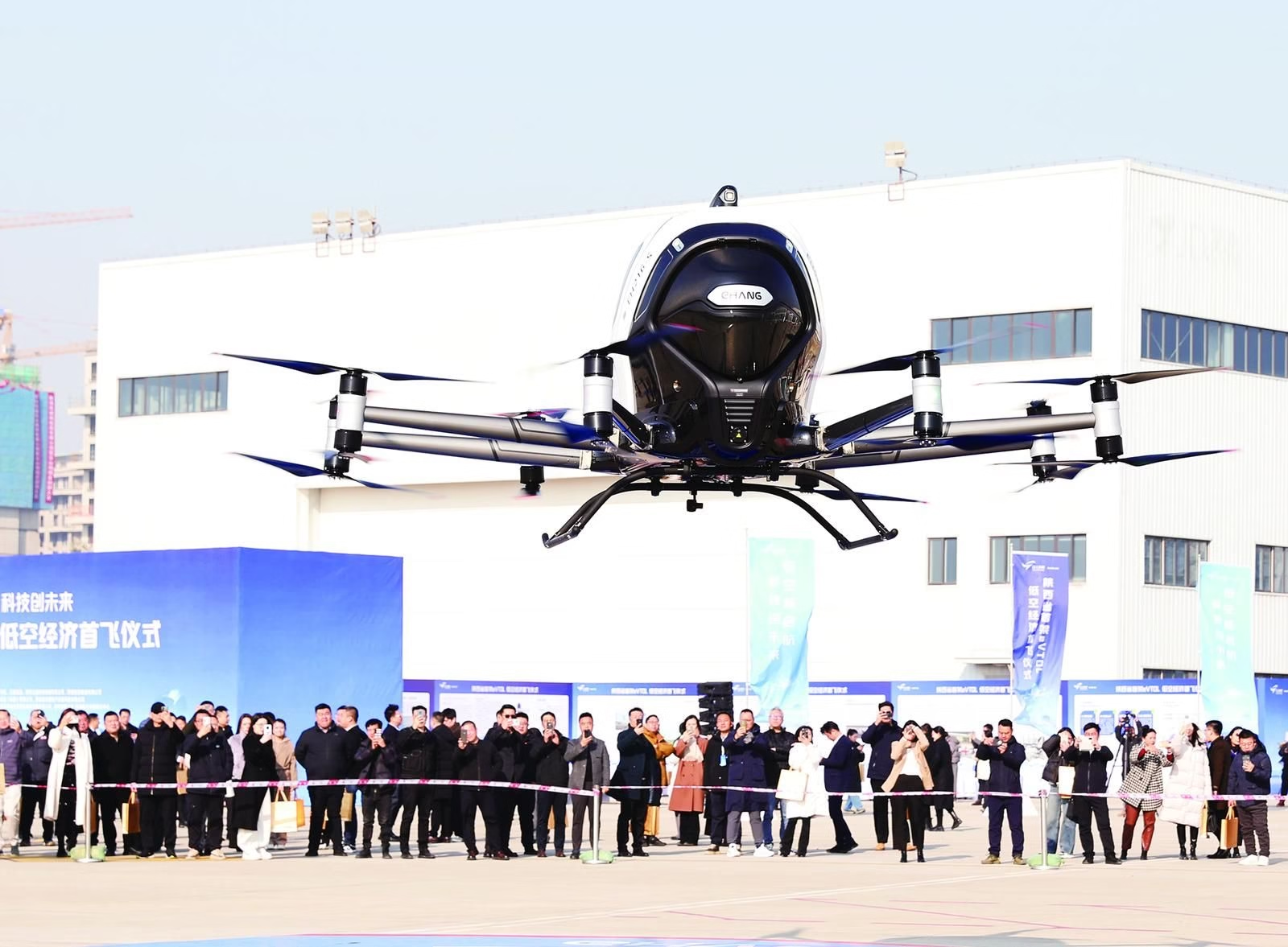
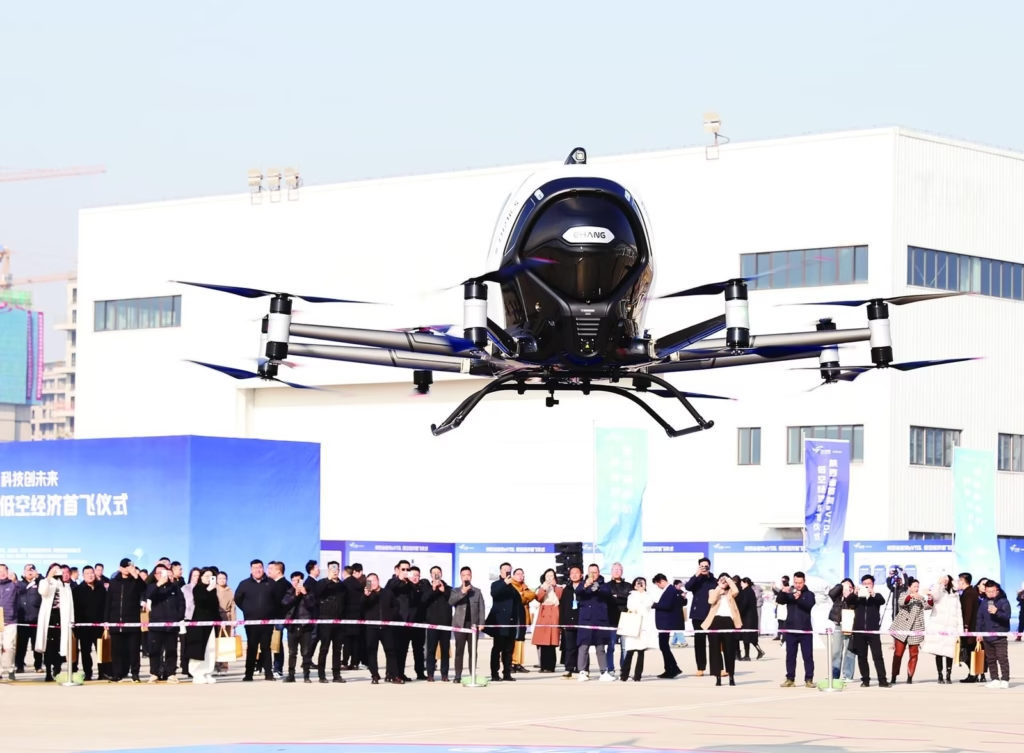
The aviation industry is on the cusp of its most transformative shift since the jet age. Electric Vertical Take-Off and Landing (eVTOL) aircraft—often called “flying taxis”—are rapidly moving from prototype demonstrations to commercial reality. With supportive government policies, surging investment, and accelerating certification timelines, 2026 is shaping up to be the year the low-altitude economy truly takes off.
A Market Poised for Exponential Growth
The numbers tell a compelling story. According to the latest industry analysis, the global eVTOL aircraft market stood at $14.36 billion in 2025 and surged to $18.92 billion in 2026—a remarkable compound annual growth rate (CAGR) of 31.7% . This momentum is expected to continue, with forecasts projecting the market to reach $41.8 billion by 2030 .
Other research firms offer even more aggressive projections. A January 2026 report valued the global eVTOL market at $1.998 billion in 2025, anticipating a 35% CAGR that would push it to $15.9 billion by 2032 . This variance reflects differing methodologies but confirms a shared consensus: eVTOL represents one of the fastest-growing sectors in transportation.
“The low-altitude economy integrates advanced technologies across aerospace, smart manufacturing, new energy, and artificial intelligence,” wrote Wang Lifeng, a professor at Nanjing University of Aeronautics and Astronautics, in a recent analysis for People’s Daily . “With long industry chains and strong driving effects, it is projected to exceed one trillion yuan ($144.76 billion) in market size during China’s 15th Five-Year Plan period” .
China Accelerates: From Strategic Industry to National Priority
China has placed eVTOL development at the center of its economic strategy. The 2026 Government工作报告 explicitly named low-altitude economy as an “emerging pillar industry,” signaling a significant upgrade from its previous designation as a “strategic emerging industry” during the 14th Five-Year Plan period (2021-2025) .
This policy shift is already yielding tangible results. On March 19, 2026, Shanghai-based eVTOL developer TCab Tech and aviation simulation leader Huamo Technology formalized a strategic partnership to accelerate eVTOL commercialization. The collaboration focuses on integrating “eVTOL complete aircraft development” with “training system construction”—a critical combination for achieving operational readiness .
TCab Tech’s flagship E20 eVTOL, featuring an advanced tilt-rotor configuration, can carry five passengers at speeds up to 320 km/h. The aircraft is designed for low-altitude tourism and efficient intercity travel within urban clusters . Huamo Technology, leveraging its expertise in full-motion flight simulators for large commercial aircraft, has developed a high-fidelity eVTOL simulator that can replace some high-risk, high-cost test flights—significantly shortening the certification timeline .
Juneyao Group Chairman Wang Junjin, who attended the signing ceremony, emphasized the broader vision: “This cross-industry collaboration is not only about technological breakthroughs but also about building a low-altitude flight assurance system that meets the highest international safety standards, driving the low-altitude economy toward large-scale commercialization” .
China’s ambition extends beyond its borders. On March 20, 2026, EHang signed a Memorandum of Understanding with three Thai companies—Bangkok Land, Aerial Sea Thailand, and China Harbour Engineering (Thailand)—to accelerate eVTOL commercialization in Thailand. This follows EHang’s first crewed flight demonstration in Thailand in November 2024 and the launch of an AAM sandbox program in October 2025 . EHang has also partnered with Guangdong University of Foreign Studies to establish a talent training base for low-altitude economy, recognizing the need for professionals who combine technical expertise with global market knowledge .
The Greater Bay Area is emerging as a particularly dynamic testing ground. According to Zhang Ruifeng, Secretary-General of the Greater Bay Area New Energy Vehicle Industry Technology Innovation Alliance, the region’s dense urban clusters and innovation ecosystem make it an ideal laboratory for “vehicle-aviation integration.” Market projections suggest the Greater Bay Area’s three-dimensional mobility market could reach 91 billion yuan by 2035 .
The United States Pushes Forward with Pilot Programs
Across the Pacific, regulatory frameworks are catching up to technological capability. In March 2026, the U.S. Federal Aviation Administration (FAA) and Department of Transportation (DOT) selected eight pilot projects under the newly launched Advanced Air Mobility and eVTOL Integration Pilot Program (eIPP) .
These projects will conduct real-world testing across 26 states, covering urban air taxi services, cargo delivery, and emergency medical response. The three-year study period will generate operational data to inform permanent safety standards, with initial operations expected to begin by summer 2026 .
The selected projects include:
- New York/New Jersey: The Port Authority will explore 12 operational concepts, including electric air taxi services connecting Manhattan Heliport with major regional airports .
- Texas: The state’s transportation department will support a regional network linking Dallas, Austin, San Antonio, and Houston, with industry partners including Archer Aviation and Joby Aviation .
- New Mexico: Albuquerque will lead a project focused on advancing autonomous operations, aiming to integrate large uncrewed aircraft systems into controlled U.S. airspace .
Beta Technologies, a Vermont-based manufacturer, was selected to participate in seven of the eight pilot programs—more than any other company. The firm plans to deploy its aircraft initially for critical cargo and medical logistics missions before expanding into passenger services .
Global Momentum: Beyond China and the United States
The eVTOL revolution is truly global. European pioneers like Volocopter, Lilium, and Vertical Aerospace continue to advance their certification efforts. Germany’s Lilium, despite recent financial turbulence, saw its patent portfolio acquired by Archer Aviation in October 2025 for $21 million—a transaction that strengthens Archer’s technological position in the competitive electric air mobility market .
South Korea, Japan, and Singapore are also positioning themselves as early adopters, with infrastructure planning and regulatory sandboxes already underway. Thailand’s engagement with EHang signals Southeast Asia’s growing appetite for urban air mobility solutions .
Applications: From Air Taxis to Emergency Response
The versatility of eVTOL aircraft enables a wide range of applications beyond passenger transport:
The cargo segment is attracting particular attention. In June 2024, U.S.-based Air Company launched the AIR ONE Cargo, an unmanned variant of its eVTOL designed to carry payloads up to 250 kg. The aircraft features advanced “fly-by-intent” technology that enhances connectivity with ground control and enables greater automation in flight management .
Overcoming Challenges: Certification, Infrastructure, and Public Trust
Despite the momentum, significant hurdles remain. The path to commercialization requires navigating three interconnected challenges:
Airworthiness Certification: Current certification frameworks were designed for conventional aircraft and do not fully accommodate eVTOL’s unique characteristics. Regulators worldwide are working to develop new standards, but the process remains time-consuming and complex .
Infrastructure Development: Widespread eVTOL adoption requires vertiports (specialized takeoff and landing areas), charging infrastructure, and low-altitude air traffic management systems. The FAA’s pilot program will evaluate infrastructure standards, including the management of downwash and outwash winds that can exceed 55.5 km per hour .
Public Acceptance: Surveys indicate lingering public skepticism about the safety and reliability of autonomous or semi-autonomous air taxis. Building trust will require demonstrable safety records, transparent communication, and gradual exposure through less sensitive applications like cargo delivery before passenger services scale .
Tariff and Supply Chain Pressures: The global trade environment adds another layer of complexity. Tariffs on batteries, electric motors, composite materials, and electronic control systems are increasing manufacturing costs and slowing production timelines. These pressures most significantly affect fully electric and hybrid-electric propulsion segments and regions heavily dependent on imported components .
The Road Ahead: 2030 and Beyond
Industry analysts envision a phased evolution. The China Society of Automotive Engineers’ “Flying Car Development Report 2.0” outlines three stages:
- 2025-2030: Commercial Takeoff — Specialized applications like emergency response, police operations, and airport shuttles lead the way .
- 2030-2035: Scale Expansion — Urban air mobility networks expand, with increasing public adoption and falling costs .
- 2035 and Beyond: Integrated Mobility — “Ground-air integrated transportation” matures, with eVTOL operating seamlessly alongside traditional ground transport .
The technological roadmap is equally ambitious. Current battery technology limits eVTOL range to approximately 100-150 miles per charge, sufficient for urban operations but insufficient for regional connectivity. Advancements in solid-state batteries, hydrogen fuel cells, and hybrid-electric systems are expected to dramatically expand operational capabilities over the coming decade .
Conclusion: A New Era in Motion
The convergence of policy support, technological maturity, and regulatory progress suggests that eVTOL is no longer a distant vision but an imminent reality. From Shanghai to Texas, from Shenzhen to Thailand, aircraft manufacturers, infrastructure providers, and government agencies are building the foundation for a new mode of transportation.
As Juneyao Group Chairman Wang Junjin noted at the TCab-Huamo signing ceremony, the goal is nothing less than “building a low-altitude flight assurance system that meets the highest international safety standards” . With market projections pointing toward $41.8 billion by 2030 and national governments treating low-altitude economy as a strategic priority, the only remaining question is not whether eVTOL will transform urban mobility—but how quickly.