
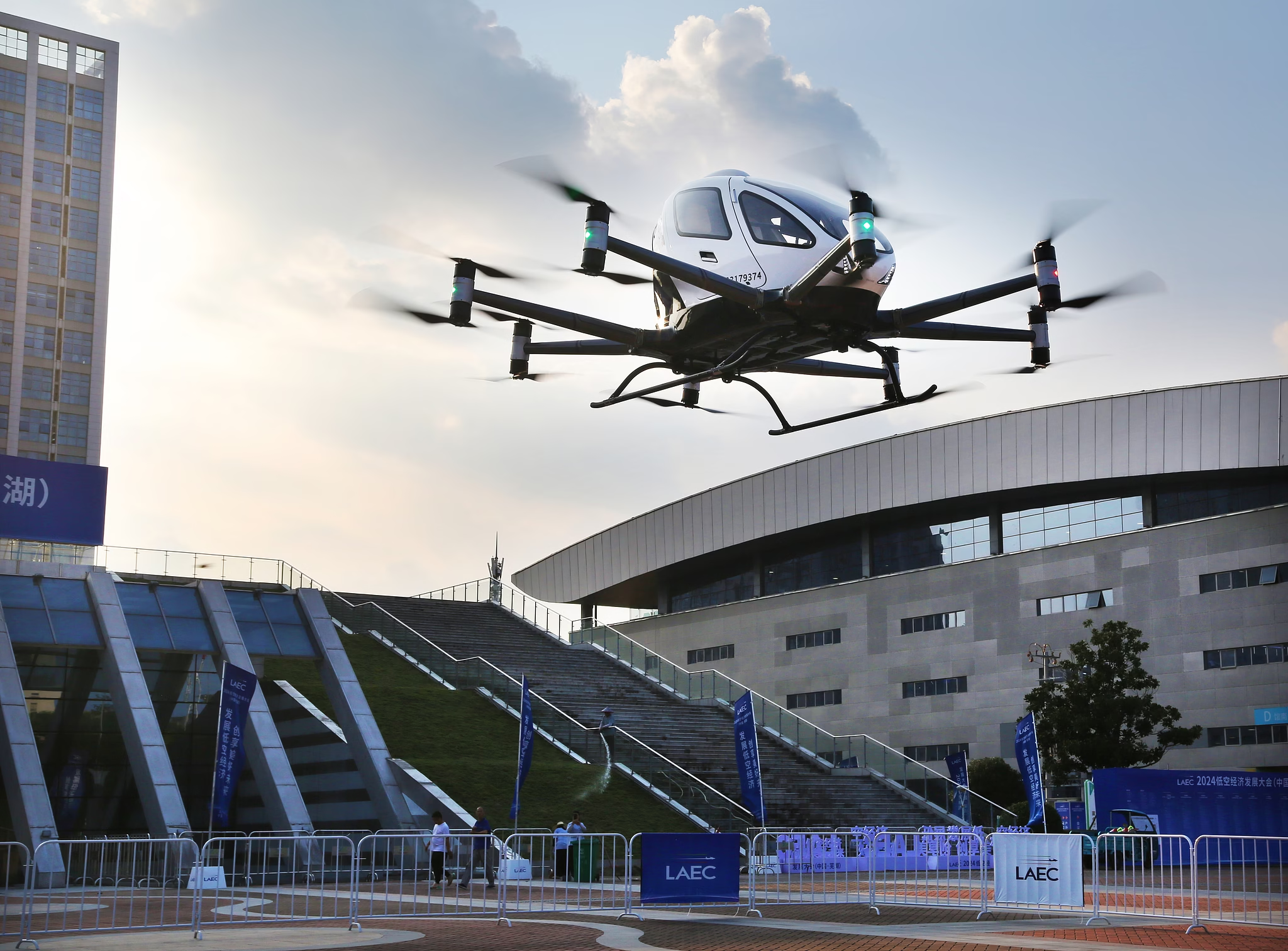
The sky above our heads has long been considered the domain of commercial airlines and the occasional helicopter. But if aerospace engineers, urban planners, and logistic giants have their way, the airspace between 300 and 3,000 feet is about to become the world’s most complex, dynamic, and valuable real estate. Welcome to the “Low-Altitude Economy” (LAE)—a paradigm shift that is turning science fiction into logistical fact.
For decades, the concept of flying cars and autonomous delivery drones felt perpetually “five years away.” However, the convergence of advanced battery technology, Artificial Intelligence (AI), and lightweight composite materials has finally pushed this sector past the tipping point. What was once a niche interest is now emerging as one of the most significant industrial opportunities of the coming decade.
A Market Taking Flight: Economic Contributions Today and Tomorrow
The economic footprint of the Low-Altitude Economy is already substantial and poised for explosive growth. According to data from the Civil Aviation Administration of China and industry analysts at McKinsey, the global LAE market—encompassing manufacturing, infrastructure, operations, and services—is estimated to have contributed roughly $100 billion to $120 billion in 2025, driven largely by commercial drone applications in agriculture, logistics, surveying, and public safety.
Yet this is merely the opening act. By 2030, the market is projected to surpass $500 billion, with some bullish forecasts reaching as high as $900 billion when including adjacent industries such as vertiport real estate, specialized insurance, and AI-driven airspace management platforms. By 2035, as autonomous passenger eVTOL (Electric Vertical Take-Off and Landing) services scale and drone delivery becomes ubiquitous in urban centers, the sector could contribute 1.5% to 2% of global GDP in high-adoption regions.
China, which has designated the Low-Altitude Economy as a “strategic emerging industry” in its 15th Five-Year Plan (2026–2030) , exemplifies the economic multiplier effect. Domestic estimates suggest that for every $1 billion invested in LAE infrastructure, the ripple effect across manufacturing, tourism, emergency services, and technology R&D generates approximately $3.5 billion in total economic output. Cities like Shenzhen—often called “Drone City”—already host over 1,500 LAE-related enterprises, collectively contributing tens of billions of dollars annually to the local economy and employing hundreds of thousands of workers.
The economic contribution extends beyond direct revenue. The LAE is creating entirely new job categories: vertiport architects, drone fleet operators, AI airspace coordinators, and high-density battery technicians. It is also offering a lifeline to traditional industries; automotive giants are pivoting to eVTOL manufacturing, while telecommunications companies are monetizing 5G/6G networks through dedicated low-altitude connectivity services.
The Engines of Growth: eVTOL, Autonomous Logistics, and AI Airspace
At the heart of this revolution is the eVTOL aircraft. Unlike the noisy, fuel-intensive helicopters of the past, these new vehicles are quiet, sustainable, and designed for autonomy. Companies like Joby Aviation, Archer Aviation, and EHang are moving beyond prototypes, securing “Production Certificates” that allow for mass manufacturing. In cities like Shenzhen, Shanghai, and soon Los Angeles, these electric air taxis are slated to begin commercial passenger service within the next 12 months, promising to turn 90-minute car commutes into 15-minute aerial hops.
However, passenger transport is only the tip of the spear. The true economic engine of the LAE is autonomous logistics. In rural China and parts of the United States, heavy-lift drones are already bypassing damaged roads to deliver medical supplies and e-commerce packages. Tech giants are investing heavily in “drone-in-a-box” infrastructure—automated docking stations that allow for continuous, swarm-based delivery networks. This isn’t just about faster shipping; it’s about creating a resilient supply chain that is immune to ground-level traffic and infrastructure failures.
The catalyst enabling this explosion is the maturation of AI-driven air traffic management. The biggest bottleneck for low-altitude flight isn’t hardware—it’s safety. Managing thousands of autonomous drones and air taxis flying below skyscraper level requires a digital infrastructure far more advanced than traditional radar. To solve this, governments and private firms are rolling out “Digital Twins”—virtual replicas of city airspace—where AI algorithms de-conflict routes, monitor weather micro-climates, and ensure that a delivery drone doesn’t cross paths with an emergency medical transport.
Regulatory Tailwinds and Strategic Recognition
Regulatory frameworks are finally catching up. The United States FAA is implementing new rules for “Powered-Lift” pilot certifications, while the European Union has established the U-space framework to govern drone traffic. But nowhere is the strategic commitment more pronounced than in China. By embedding the Low-Altitude Economy into its 15th Five-Year Plan, Beijing has unlocked billions in government funding, accelerated the construction of vertiports, and fast-tracked approval for urban air mobility pilot zones across cities like Shenzhen, Guangzhou, and Chengdu. The Plan’s emphasis on “new quality productive forces” positions LAE as a cornerstone of China’s next-generation economic transformation—on par with new energy vehicles and advanced semiconductors.
Future Growth Potential: Beyond 2035
Looking further ahead, the long-term growth potential of the Low-Altitude Economy hinges on three key developments: battery energy density breakthroughs, full autonomy certification, and public acceptance. Current battery technology limits eVTOL ranges to approximately 100–150 miles per charge, sufficient for urban air mobility but insufficient for regional connectivity. Once solid-state batteries or hydrogen fuel cells mature, the operational radius will expand dramatically, opening inter-city routes.
Additionally, as AI air traffic management systems prove their safety record over millions of flight hours, regulators will begin approving single-pilot and eventually fully autonomous passenger operations—dramatically lowering operational costs and making air taxi fares competitive with ride-hailing services.
China’s low-altitude economy, which encompasses activities in airspace below 1,000 meters, is entering a significant growth phase. Recent data indicates that the market is expected to reach 1.5 trillion yuan (approximately $210 billion) by 2025 and could exceed 2 trillion yuan (around $280 billion) by 2030. This sector includes various applications such as drone delivery, aerial tourism, emergency rescue, and low-altitude logistics, showcasing its diverse potential. In this vision, low-altitude airspace becomes a layered, digitally managed utility: delivery drones operating below 500 feet, air taxis cruising between 1,000 and 2,500 feet, and cargo drones shuttling between suburban distribution hubs—all seamlessly integrated into the daily fabric of urban life.
Challenges on the Horizon
Critics warn of looming challenges. The whir of hundreds of delivery drones could introduce a new type of urban noise pollution. Cybersecurity also remains a primary concern; a coordinated hack of a drone swarm could paralyze a city’s logistics network. Furthermore, the industry faces a looming shortage of skilled operators and maintenance technicians specialized in electric propulsion systems. Public skepticism regarding safety and privacy will also require transparent communication and demonstrable reliability.
Conclusion: The Vertical Expansion of the Smart City
Nevertheless, the momentum appears unstoppable. As 5G and eventually 6G networks blanket urban centers, the latency required for safe autonomous flight is finally achievable. The Low-Altitude Economy represents more than a new mode of transport; it represents the vertical expansion of the smart city. We are no longer just building outward; we are building upward into the previously unused layer of air just above our heads, transforming it into a bustling, intelligent utility that will power economic growth for decades to come.