
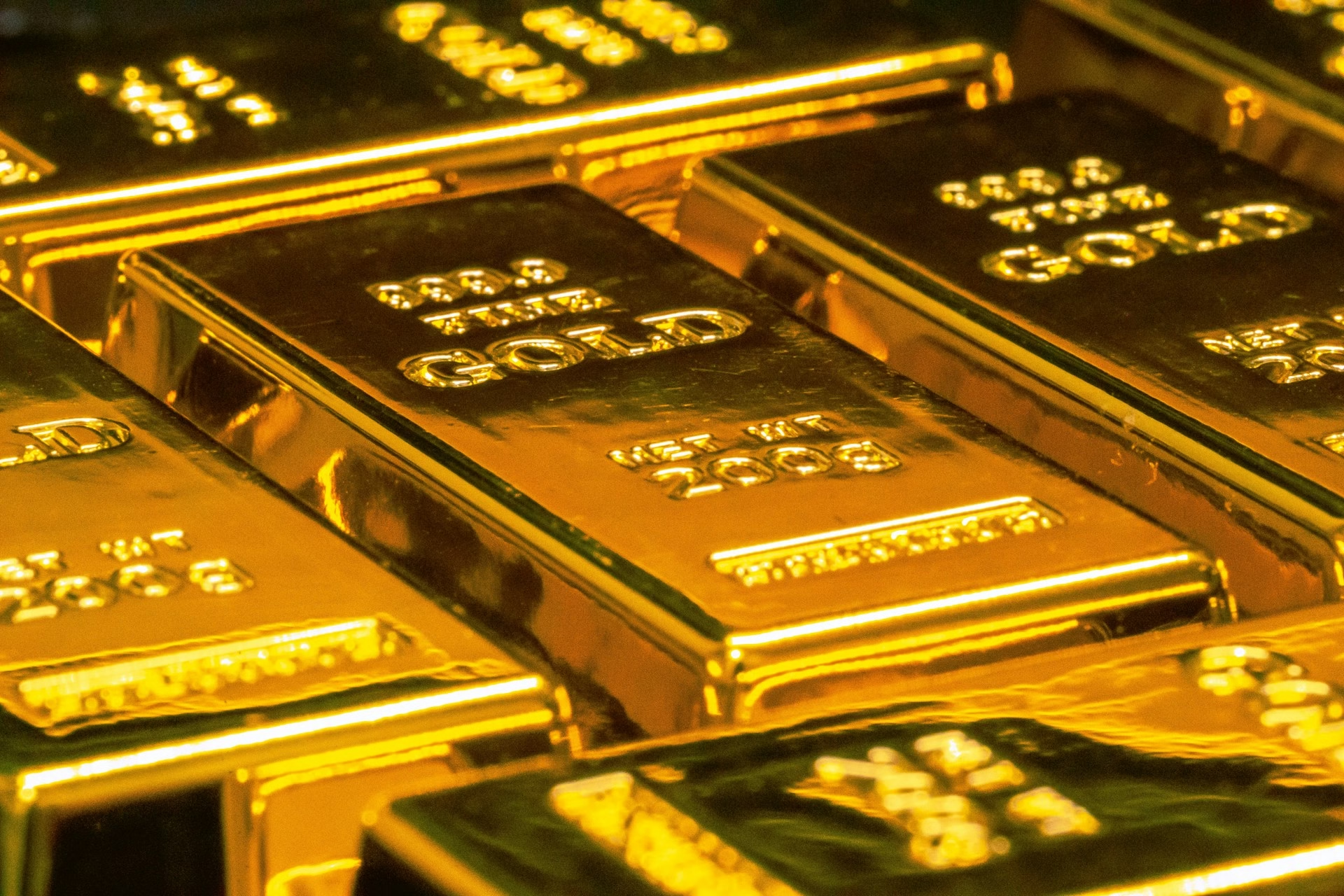
Gold has officially entered a new era. This week, international spot prices shattered the $5,300 per ounce mark, while in India, 24-carat gold surged past ₹1,65,000 per 10 grams. From the skyscrapers of Shanghai to the jewelry hubs of London, the world is scrambling for a metal that was forged in the hearts of dying stars billions of years ago.
While the “rate” is what’s trending, the story behind the rise is a complex mix of 2026 geopolitics and the fundamental laws of physics.
1. The Geopolitical “Tinderbox”
Gold is known as the “crisis commodity,” and 2026 has provided plenty of it.
- The Greenland & Venezuela Conflicts: Prices spiked following the US administration’s aggressive moves to secure mineral rights in Greenland and military escalations in Venezuela. These events have triggered fears of a broader conflict, pushing investors out of stocks and into the safety of gold.+1
- US-Europe Trade War: New tariffs imposed on European nations have destabilized the Euro, leaving gold as the only “neutral” currency that no government can print or devalue.
2. The “De-Dollarization” of Central Banks
For the first time since 1996, gold now accounts for a larger share of global central bank reserves than US Treasuries.
- China’s 14-Month Buying Spree: The People’s Bank of China has added to its reserves for over a year straight, aiming to insulate its economy from US dollar volatility.
- India’s Domestic Hunger: Beyond the Reserve Bank of India’s accumulation, the 2026 wedding season has met a “supply squeeze.” With the Rupee at a historical low, the landed cost of gold has made every gram a high-stakes investment for Indian households.
3. The Science: Why Gold Can’t Just Be “Made”
The reason these nations are fighting over gold is its absolute physical scarcity. For a science-focused reader, the value isn’t just in the shine—it’s in the atomic structure.
The Kilonova Factory (Astrophysics)
Gold is rare because the universe is remarkably inefficient at making it. Most elements are forged in standard stars, but gold requires a Kilonova—the collision of two neutron stars.
These events are so rare that every piece of gold ever mined on Earth is a “fossil” of a cosmic explosion that happened before our solar system even existed. We cannot “manufacture” gold in a lab at scale because we cannot replicate the pressure of a collapsing star.
The Relativistic Metal (Quantum Physics)
Why is gold so vital for 2026 technology? It’s due to Special Relativity. Inside a gold atom, electrons move at roughly 50% the speed of light. This relativistic effect makes gold:
- Yellow: The speed of the electrons shifts the light absorption from the UV range into the visible spectrum.
- Indestructible: It is the most non-reactive metal, making it essential for the 5G towers and AI servers powering the 2026 tech boom.
4. Economic “Safe Haven” vs. Industrial Demand
As US unemployment creeps toward 4.4% and recession fears loom, gold serves a dual purpose. It is a hedge against a failing paper economy, but it is also a physical requirement for the green energy transition. From satellite connectors to high-efficiency solar panels, the world’s most “precious” metal is also its most “practical.”
Conclusion: A Strategic Anchor
Whether it’s a hedge against global trade wars or a cultural necessity, gold’s 2026 rally proves that in an era of digital uncertainty, humanity still looks to the stars—and the periodic table—for ultimate stability.